Organisation · Interwar Prague · Ukrainians in Czechia · R0035
Ukrainian Economic Academy in Poděbrady
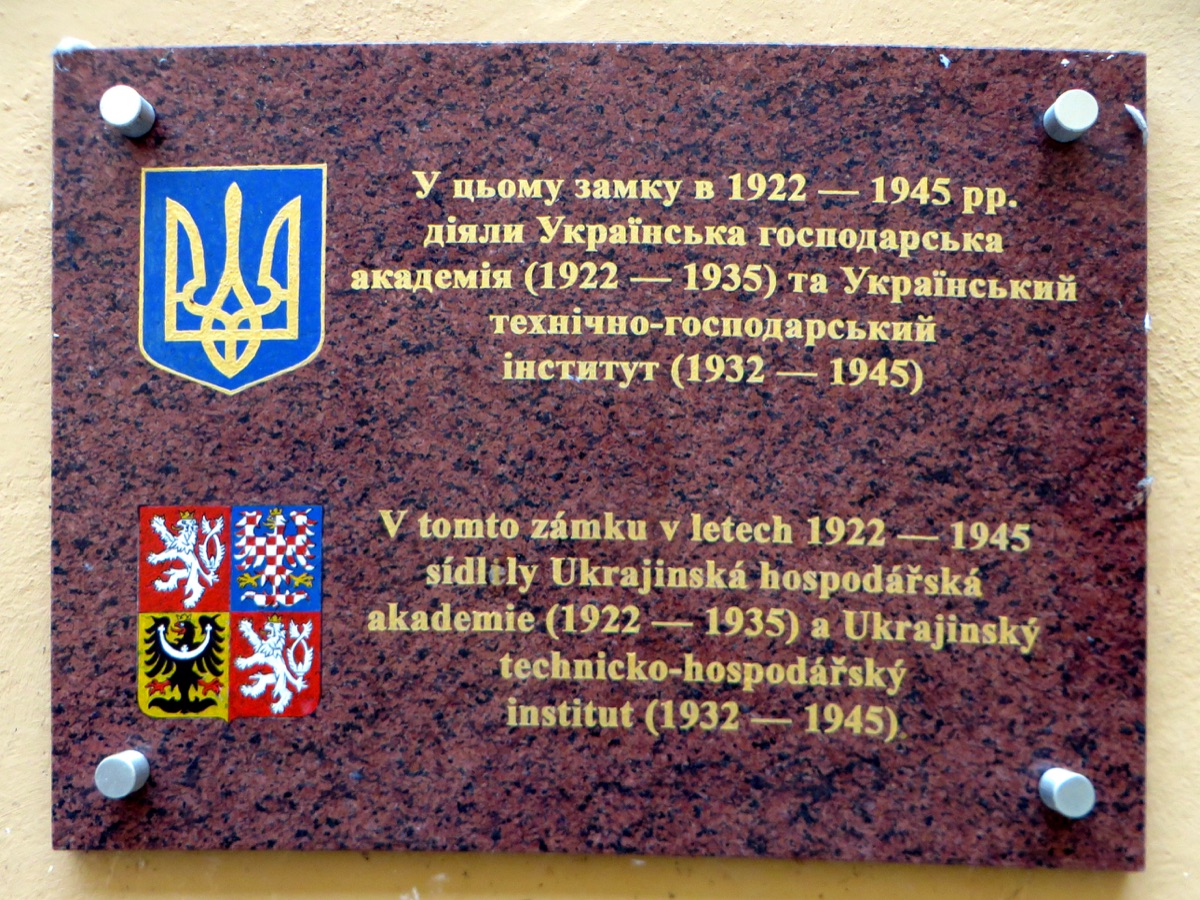
Українська господарська академія · Ukrajinská hospodářská akademie v Poděbradech · 1922–1945
Essence
Established in Poděbrady in 1922 with Czechoslovak support, the Ukrainian Economic Academy educated Ukrainian émigrés in engineering, agriculture, forestry and economics. It also developed publishing and academic activities and brought together Ukrainian and Czech teachers. After its closure in 1935, the Ukrainian Technical-Economic Institute continued related educational work. Archival records preserve curricula, student photographs and financial documents.
Timeline
- 16.05.1922Ministerial decision on which the academy’s creation was based [A04]
- May 1922Organisation of the UEA by the Ukrainian Civic Committee, Czechoslovak support [A01; A02]
- 1922Start of teaching; publishing society [A02; A09]
- 23.05.1925Dated UEA statute [A01: fond 269, inventory 1, file 436]
- 1925Extension of study from three to four years [A01]
- 1926/27According to the encyclopedia, a maximum of 613 students [A07]
- 04.12.1926Scholarship payroll [A01: fond 269, inventory 1, file 444]
- 1927Admission announcement, budget, student documents [A01]
- 29.09.1929Shapoval’s letter on the condition of Ukrainian higher schools [A01: fond 269, inventory 2, file 85]
- 14.12.1929Teachers’ protest against arrests in Ukraine [A01: fond 269, inventory 1, file 1093]
- 1931Public appeal in defence of the academy [A01: fond 269, inventory 1, file 442]
- 12.11.1932Creation of the UTEI as a correspondence-education branch [A05]
- 1935 / 1936End of UEA work and administrative formalisation of liquidation [A01; A02]
- 1945Relocation of the UTEI to Germany [A02; A05]
Full research text
Significance for the project
The Ukrainian Economic Academy (UEA) in Poděbrady is one of the most concrete examples of cooperation between Ukrainian émigrés and Czechoslovakia: in 1922, Czechoslovak government funding and the Ukrainian Civic Committee’s initiative created a private technical higher school with a Ukrainian cultural orientation. The academy trained agronomists, foresters, hydraulic engineers, chemical technologists and cooperative-economics specialists; its students came mainly from the Ukrainian émigré community. Poděbrady became a hub of Ukrainian student, publishing, artistic and scouting networks as well as a teaching location. [A01; A02; A03]
Editorial narrative: “A Ukrainian polytechnic in a Czech castle”. One building and documentarily attested subjects of study can tell Czech audiences about Ukrainian engineers, support from the Czechoslovak Ministry of Agriculture, student cooperatives and exchanges of scholarly books. Architectural photographs should be taken separately; historical interiors must not be replaced by present-day rooms without evidence. [A02; A04]
Profile, governance and chronological limits
| Attribute | Editorial value |
|---|---|
| Full name | Ukrainian Economic Academy in Czechoslovakia (UEA); variant “Ukrainian Economic Academy in Poděbrady” |
| Historical location | Poděbrady, Czechoslovakia; teaching is associated with Poděbrady Castle, but precise classrooms have not been identified |
| Legal / educational type | Private higher school with a polytechnic profile; support and supervision by Czechoslovak authorities |
| Date of regulatory foundation | Czechoslovak ministerial order of 16.05.1922 [A04] |
| Start of teaching | June 1922; a separate study gives 22.06.1922 [A09] |
| Academic faculties | Agronomy and forestry; engineering; economics and cooperation [A01; A02] |
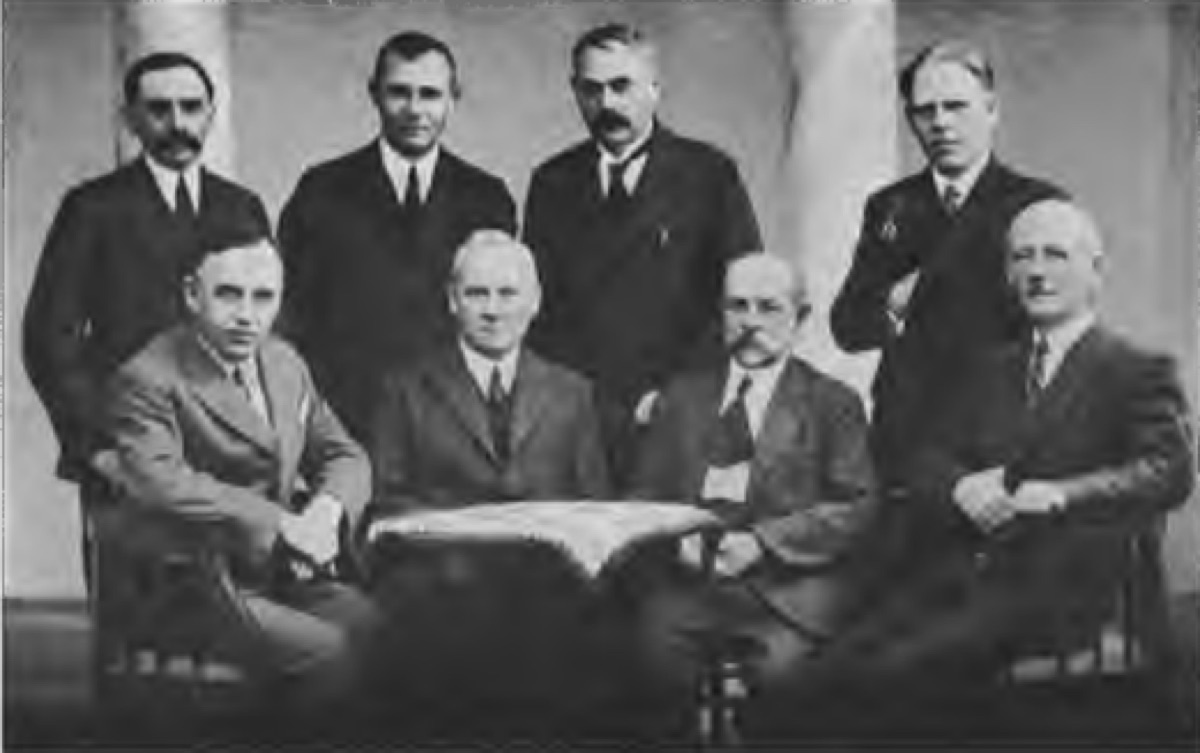
| Rectors | Ivan Shovheniv (R0030), Borys Ivanytsky (R0031), Serhii Tymoshenko (R0032); precise dates of each term are an archival task [A02] |
| Closure | End of activities in 1935; formal government / ministerial acts at the 1935–1936 boundary [A01] |
| Continuation of educational work | Ukrainian Technical-Economic Institute (UTEI), from 1932 as a correspondence-education branch, subsequently an independent institution [A02; A05] |
| Related institution | UFU (R0034) — parallel institution, rather than a UEA subdivision |
Foundation and the three faculties
Ukrainian initiative and Czech support. The UEA’s foundation is linked to the Ukrainian Civic Committee in Czechoslovakia (R0039), headed by Mykyta Shapoval (R0003). The legal basis was a decision of the Czechoslovak Ministry of Agriculture; support included budget funding, making tuition free and providing many students with scholarships. It is incorrect to personalise the decision solely through Masaryk: government departments, the Ukrainian committee, teachers and local infrastructure participated in the process. [A01; A02; A04]
Faculty of Agronomy and Forestry. It combined agronomy, forestry and field training. Classroom history can lead to teaching farms, laboratory equipment and professional practice. The central archive describes teaching-farm documents, inventory books, agronomy programmes and equipment requests — specific archival points for a future exhibition on Ukrainian engineering education. [A03; A06]
Faculty of Engineering. Specialisations included hydraulic engineering and chemical technology. The existence of these fields justifies a separate engineering exhibition, but does not confirm that students completed specific realised Czech construction projects. Such practical work must be sought in diploma registers and placement records. [A06; A07]
Faculty of Economics and Cooperation. It trained specialists in economics, cooperation and statistics; links to the Ukrainian civic sector can be traced through the curriculum and publishing. A publishing society emerged in 1922, supporting technical and humanities publications. The library collected Czech, Ukrainian and other-language specialist literature. [A02]
Students, teaching and numerical contradictions
The Czech National Library’s Slavonic Library gives 786 admitted students, and 118 teachers over the first ten years (92 Ukrainians and 26 Czechs). These figures have different denominators: admissions over the entire period and teachers over the first ten years. They cannot be added into a single “UEA population figure”. The Encyclopedia of Ukraine also gives a peak concurrent enrolment of 613 students in the 1926/27 academic year. [A02; A07]
The number of qualified engineers needs a note. The central archive and Encyclopedia of Ukraine give 559; a historical journalistic text from 1942 gives 560; later encyclopedic copies sometimes give 569. The encyclopedic breakdown is 125 agronomists + 92 foresters + 58 chemical technologists + 117 hydraulic engineers + 167 economists = 559. The website should present 559 only with explicit attribution and a note about alternatives, while the exact count must be checked against original diploma books. [A01; A07; A08]
Education was not limited to technology. The UEA organised Ukrainian-studies courses, its own student associations and publishing activity; surviving 1933 programmes confirm that professional skills developed alongside cultural education. [A01]
The struggle for survival and the UTEI
Initial funding from Czechoslovakia later declined. The UEA gradually sought cheaper teaching formats, and in 1932 the Ukrainian Technical-Economic Institute was established for correspondence education. TsDAHO gives the precise founding date of this branch as 12.11.1932. In 1935, following the UEA’s closure, the UTEI continued as an independent institution. These are two related but non-identical legal entities, requiring separate records in the future catalogue. [A02; A05]
After the Second World War, the UTEI moved from Poděbrady to western Czechoslovakia and then to Regensburg in Germany. The Czech Slavonic Library covers Prague and Poděbrady materials from 1925–1942, while TsDAHO holds other bodies of fond no. 457. Graduates’ biographies should therefore extend beyond 1935, while identifying the institution where they studied. [A02; A05]
Archival research routes and future exhibits
| Custodian / complex | Fond or reference | What to obtain |
|---|---|---|
| TsDAVO of Ukraine | fond 3795, inventory 1, 2306 files, 1922–1938 | diplomas, minutes, students, finances, placements |
| TsDAHO of Ukraine | fond 269, inventory 1, file 436, folios 1–11 | statute of 23.05.1925 |
| TsDAHO of Ukraine | fond 269, inventory 1, file 439, folios 5–7 | diploma examination regulations |
| TsDAHO of Ukraine | fond 269, inventory 1, file 481, folio 161 and verso | student photograph of 17.05.1926 |
| TsDAHO of Ukraine | fond 269, inventory 1, file 443, folio 2 and verso | 1927 budget |
| TsDAHO of Ukraine | fond 269, inventory 1, file 441, folios 10–12 verso | Ukrainian-studies courses, 1933 |
| Slovanská knihovna, NK ČR | T-UHA; 25 items, 2 boxes | correspondence, individuals, records, disciplinary rules |
| Národní archiv Praha | MZV-RPA 98–102, UM 9 and UM 17 | Czech ministerial decisions, emigration policy |
| Státní okresní archiv Nymburk | UEA Poděbrady fond | local administration, premises, contracts |
| TsDAHO of Ukraine | fond 457 | history of the subsequent UTEI |
These references describe fonds or items, rather than claiming that every original file has been examined. Scan publication requires obtaining reuse conditions from each custodian. [A01; A02; A03; A05]
Connections
Mentioned in dossiers
- Andrij Jakovliv · Person
- Fedir Shcherbyna · Person
- Vasyl Bidnov · Person
- Oleksander Mytsiuk · Person
- Edvard Beneš · Person
- Maksym Slavinskyj · Person
- Ivan Šovheniv · Person
- Borys Ivanyckyj · Person
- Serhij Tymošenko · Person
- Hřbitov v Poděbradech-Kluku · Place
- Stylet i stylos – Yevhen Malaniuk · Work
- Ukrainian emigration in interwar Czechoslovakia · Event
- Relocation of the Ukrainian Free University from Vienna to Prague (1921) · Event
- Founding of the Ukrainian Economic Academy in Poděbrady (1922) · Event
Sources
- A01 TsDAHO of Ukraine. Archival exhibition on the anniversary of the UEA’s foundation; documents of fond 269. tsdahou.archives.gov.ua
- A02 Slovanská knihovna, NK ČR. Ukrainian Economic Academy and Ukrainian Technical-Economic Institute (1922–1945), T-UHA. sbirkysk.nkp.cz
- A03 TsDAVO of Ukraine. Fond 3795, inventory 1, 2306 files. e-resource.tsdavo.gov.ua
- A04 National University of Kyiv-Mohyla Academy Library. Ukrainian Technical-Economic Institute collection, information on the decision of 16.05.1922. library.ukma.edu.ua
- A05 TsDAHO of Ukraine. History of the UTEI, fond 457, date 12.11.1932. e.tsdahou.archives.gov.ua
- A06 Historical archival inventories of the UEA, fond 3795. e-resource.tsdavo.gov.ua
- A07 Internet Encyclopedia of Ukraine. Ukrainian Husbandry Academy. encyclopediaofukraine.com
- A08 Reprint of the historical text «Українська Господарська Академія в Под'єбрадах» (1942). zbruc.eu
- A09 Istorychna Pravda. «Фортеця української вільної науки» (2020). istpravda.com.ua
- A10 Encyclopedia of Ukrainian Studies (historical text), giving the alternative figure 569. litopys.org.ua
- A11 Historical survey of Plast: «Нарис з історії Пласту в середовищі українських емігрантів (1920–30-ті рр.)». 100krokiv.info
Photos and videos
Verification
Draft
Research draft with sources; independent check still pending.
How we verify
- DraftResearch draft with sources; independent check still pending.
- Checked automaticallyQuotes mechanically matched to sources; an independent model found no contradictions.
- Two sources (automatic score)Automatic evidence score: key facts rest on at least two independent sources. No person has yet read the whole dossier.
- Confirmed by an editorAn editor confirmed the dossier; the reason is shown on the page. This is not an independent scholarly review.
- Disputed pointsSources disagree; disputed points are marked in the text.
Report an error or add information
Your message goes to the editorial queue. AI pre-sorts it, a human decides.