Person · National revival · Ukrainians in Czechia · R0018
Oleksandr Oles
Олександр Олесь · 1878–1944
Essence
Oleksandr Oles (1878–1944), born Oleksandr Kandyba, was a Ukrainian poet and playwright whose Prague residence began in 1923 or 1924 according to conflicting sources, and continued until his death. His émigré writings combined lyric poetry and Ukrainian historical memory. He wrote a poem commemorating T. G. Masaryk. Originally buried in Prague, he was reinterred in Kyiv in 2017. [O01; O02]
Timeline
- 05.12.1878Birth of Oleksandr Kandyba. [O01; O03]
- 1907First collection, Z zhurboiu radist obnialas. [O01; O03]
- 1911Work in Kyiv’s cultural and publishing circles. [O03]
- 1919Departure from Ukraine and residence in Budapest. [O01; O03]
- 1920Vienna period; editing Na perelomi. [O01; O03]
- 1923/1924Beginning of residence in Prague: the Encyclopedia of Modern Ukraine gives 1923, whereas Encyclopedia of Ukraine and the Vernadskyi Library give1924; the exact year remains unresolved. [O01; O03; O04]
- 1930Historical poetry about the princely era. [O01; O07]
- 1931Komu povim pechal moiu. [O01]
- 1935The drama Zemlia obitovana. [O04; O07]
- 1937Poem dedicated to Masaryk’s memory. [O02]
- 10.06.1944Death of his son Oleh Olzhych. [O07]
- 22.07.1944Death in Prague. [O01; O03]
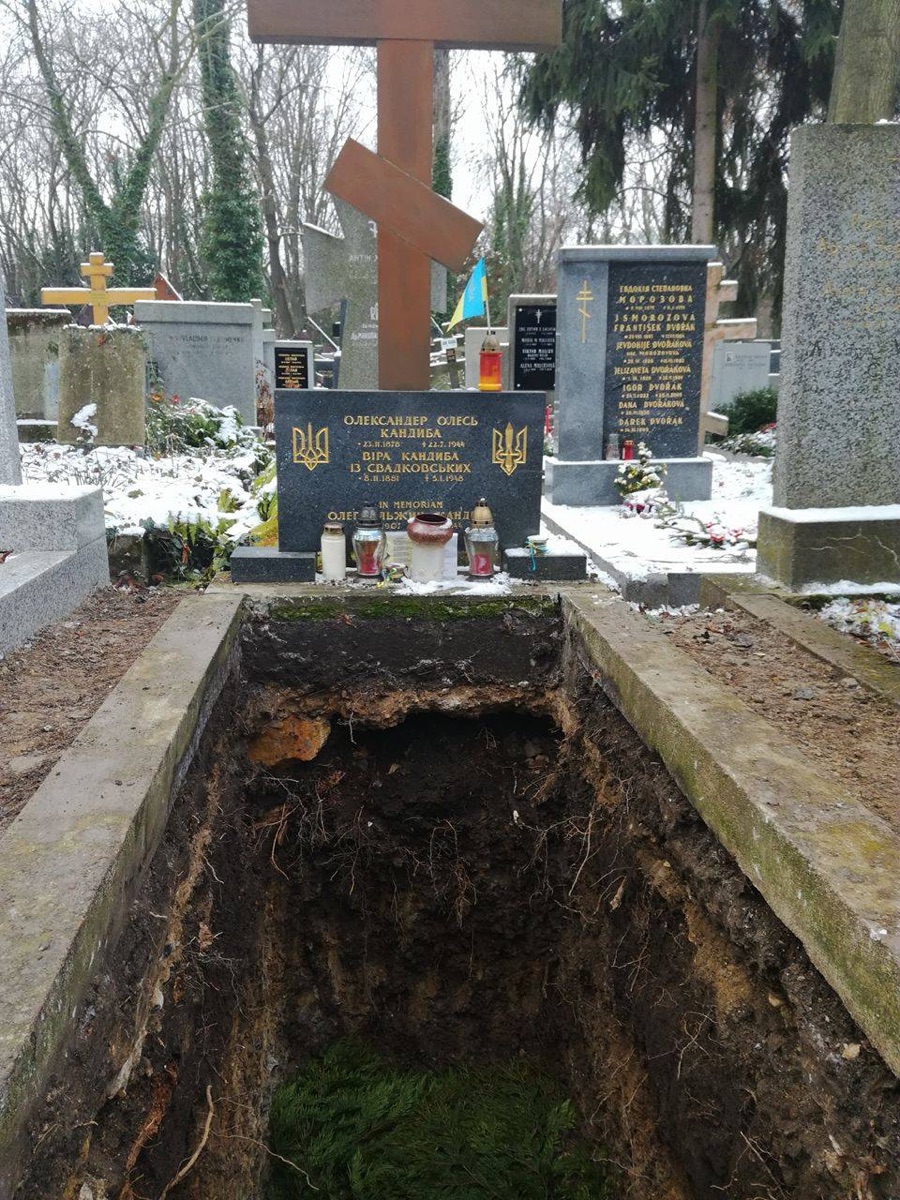
- 29.01.2017The couple’s reburial in Kyiv. [O02; O05]
Full research text
Why this story matters to Czechia
Oleksandr Oles is one of the most distinctive literary figures of Ukrainian emigration in interwar Czechoslovakia. After his period in Vienna, Prague became his long-term home: he wrote and published books, experienced separation from Ukraine and the drama of twentieth-century Europe, and eventually died there. His biography reveals another Prague to Czech readers: a city where Ukrainian remained a living cultural language even as many of its speakers had to live outside their own state. [O01; O03; O04]
His legacy extends beyond homesickness. Oles wrote lyric poetry, drama, historical verse and works for children; his books can introduce Ukrainian literature to Czech readers unfamiliar with it. His commemoration in 2017 also shows two countries preserving someone's memory together. Gratitude to Czechia should be expressed through facts and specific actions, without uncritical heroisation. [O01; O02; O05]
Identity and early life
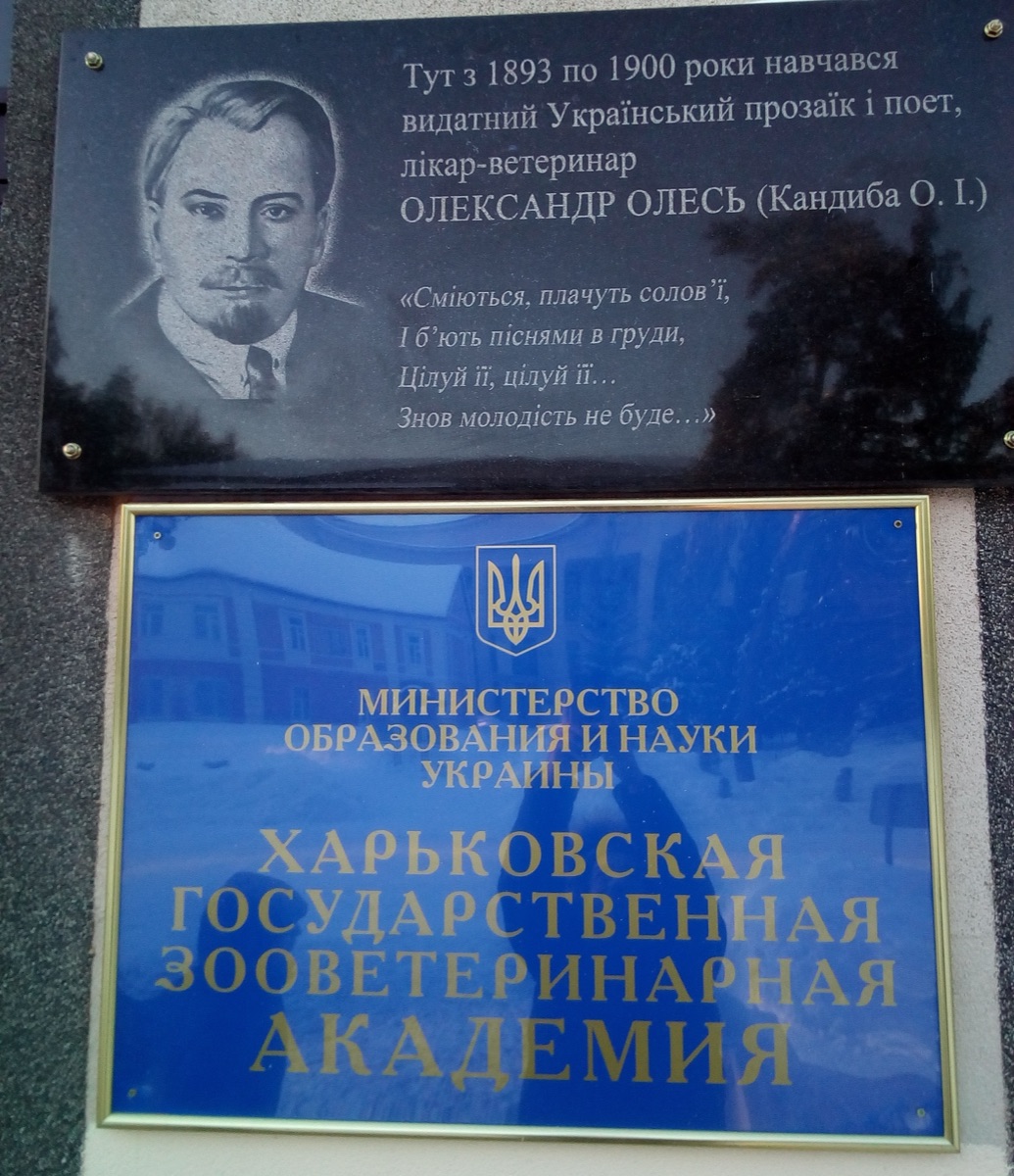
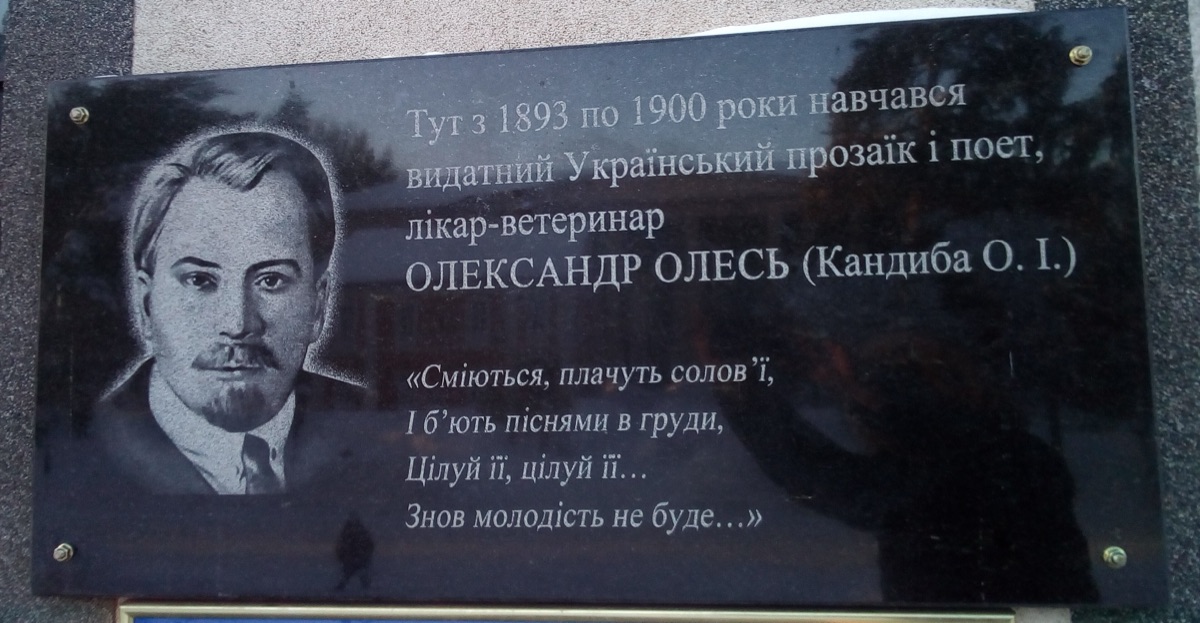
Born in Sloboda Ukraine on 23 November 1878, or 5 December in the New Style calendar, the future poet was Oleksandr Kandyba; “Oles” became his pen name. Education, veterinary training and early work with books preceded wider literary recognition. His first poetry collection, Z zhurboiu radist obnialas (1907), was an important event in Ukrainian literary life. He later worked in Kyiv, participated in editorial and publishing work, and continued writing poems, stage works and poetry for children. [O01; O03; O06]
Oles's work expressed love and anxiety as well as the Ukrainian community's historical experience. Bibliographical analysis must not place every work in his Prague period: several books, dramatisations and translations preceded emigration. Separate written_date, first_edition_year, publication_city and later_reprint fields prevent Kyiv or Vienna editions being represented as Prague publications. [O01; O04]
The emigration route: Budapest, Vienna and Prague
In 1919 Oles left Ukraine for Budapest, where he was connected with the Ukrainian People's Republic's diplomatic mission. He later lived in Vienna, edited Na perelomi and participated in Ukrainian journalists' and writers' activities. The Vernadskyi Library and Encyclopedia of Ukraine date the start of residence in Prague to 1924, whereas the Encyclopedia of Modern Ukraine gives 1923. Without comparison of address books and residence documents, the exact year remains unresolved. A map showing “Oles's Prague home from 1919” would therefore confuse the start of emigration with the Prague stage. [O01; O03; O04]
His Prague years require research into residential addresses, correspondence with publishers, cultural participation and organisational cooperation. The Vernadskyi Library describes correspondence with many cultural figures and mentions archives covering his early life and emigration. A letter establishes contact, but not necessarily close friendship, shared political views or a joint project. These relationships need distinct types. [O04]
In the 1930s he turned to historical subjects, writing the drama Zemlia obitovana in 1935 against the background of violence and catastrophes in Soviet Ukraine. The historical selection Kniazha Ukraina needs separate bibliographical checking against title pages because catalogues may conflate titles and reprint years. [O07; O01]
A shared cultural context with Tomáš Masaryk
A particularly interesting material expression of cultural gratitude is Oles's poem on Tomáš Garrigue Masaryk's death in 1937. The Czech Embassy in Kyiv included an image of it in its account of Oles's reburial in 2017. This does not establish personal friendship between the poet and president; appropriate relationship types are dedicated_poem_to or memorialized_by_poem. The first publication's bibliographical details, Ukrainian text and permission to reproduce the image still need obtaining. [O02]
The story shows Czechoslovakia's intellectual influence and support for Ukrainian emigration. It does not justify assuming that Masaryk personally edited or funded Oles's work: no such relationship is established in the located sources. Any personal contact requires letters or audience records. [O02; O08]
Family, final years and death
Oles was the father of the poet and archaeologist Oleh Kandyba — Oleh Olzhych. These are separate cultural and historical itineraries connected by family, with different biographies and political circumstances. Olzhych died in 1944; his father died in Prague on 22 July that year. Historical accounts stress that he already knew of his son's death. Without medical or direct testimony, however, the causal claim that “he died because of that news” requires caution. [O03; O07]
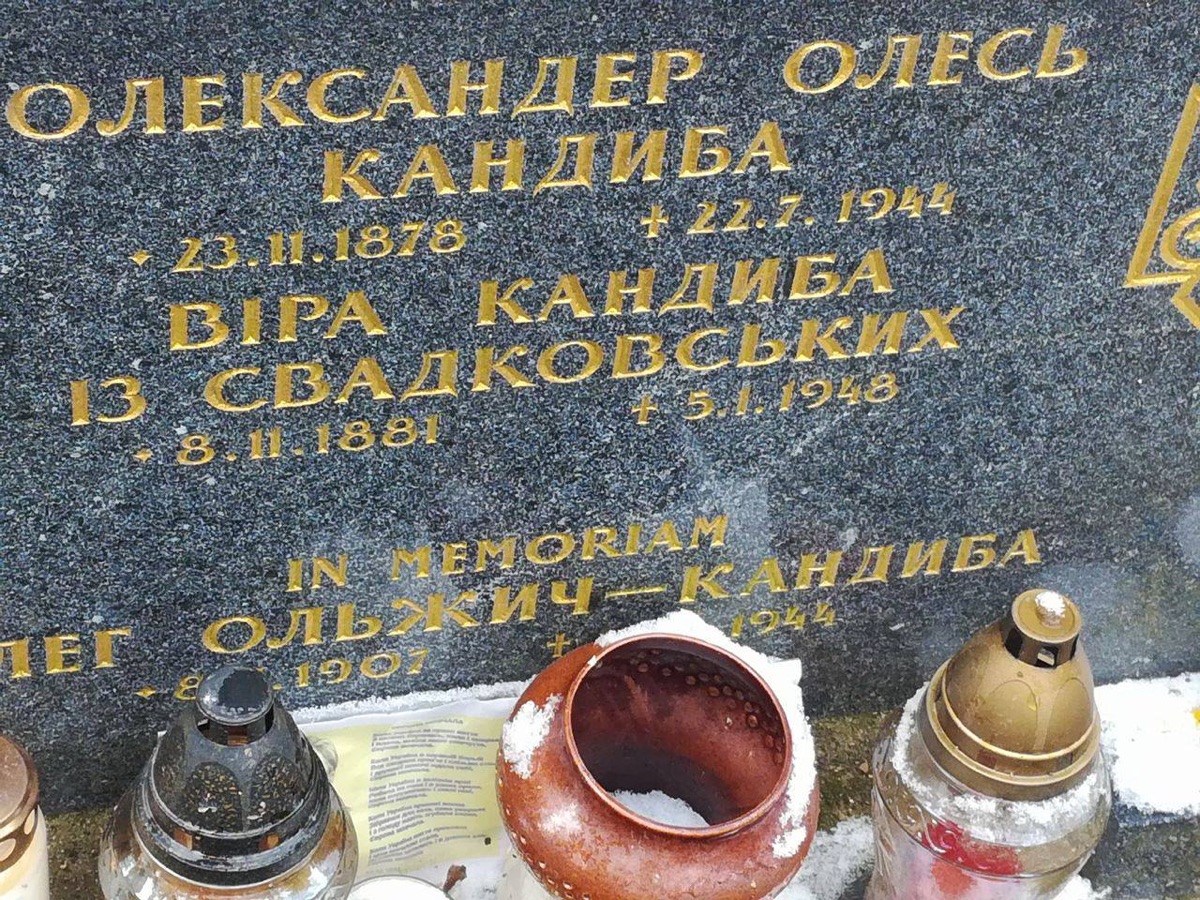
Oles and his wife Vira Kandyba were buried in Prague's Olšany Cemetery after their deaths. Their remains were transferred to Ukraine in early 2017; reburial took place on 29 January at Kyiv's Lukianivske Cemetery, with the Czech ambassador attending the mourning ceremony. This story therefore has two geographical locations and a dated transfer event. [O02; O05]
Books and cultural objects
A separate works catalogue could include Z zhurboiu radist obnialas (1907), Po dorozi v kazku (a stage work: production and printing years must be separated), Chuzhynoiu, Perezva, Komu povim pechal moiu (1931), Mynule Ukrainy v pisniakh, Zemlia obitovana (1935), children's books and translations. These dates are catalogue starting points; exact publication details need copies held by the Czech National Library, Slavonic Library and Vernadskyi Library. [O01; O03; O04; O07]
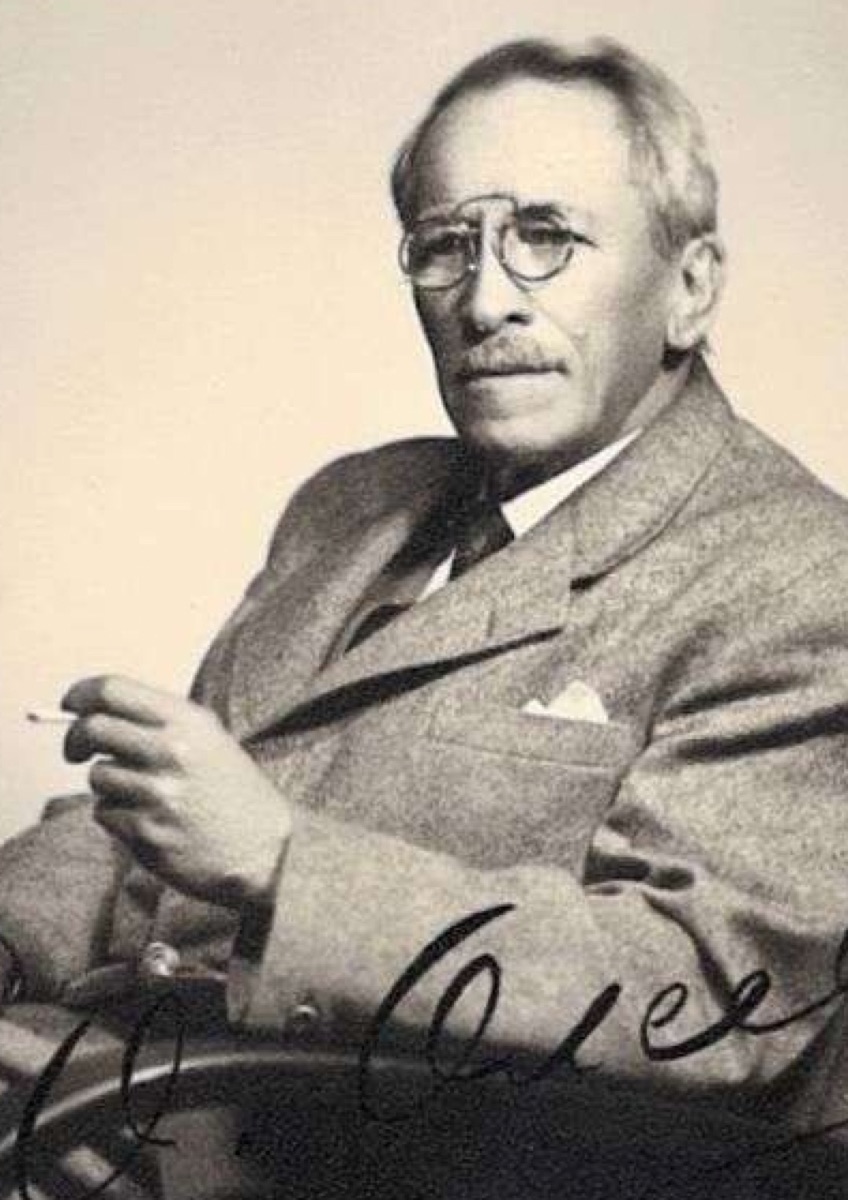
Particularly valuable exhibition objects include a Prague photograph of the poet, a Prague edition's cover, the poem commemorating Masaryk, a manuscript or letter to a contemporary, historical Olšany photographs and records of the 2017 ceremony. Each object needs its own image-rights status. Free access to a digital catalogue does not license publication of scans. [O02; O04]
Connections
Mentioned in dossiers
- Spyrydon Čerkasenko · Person
- Oleh Olžyč · Person
- Mykhailo Hrushevsky · Person
- Olšany Cemeteries · Place
- Historické prostory Univerzity Karlovy · Place
- Prague edition of the Kobzar, 1876 · Work
- Reburial of Oleksandr Oles and Vira Kandyba in Kyiv (2017) · Event
Further reading about this person
A catalogue confirms the bibliographic record. It does not mean that every dossier claim has been checked against the book’s full text.
-
Works by this person
Твори: у 2 томах
Олександр Олесь; упорядник Ростислав Радишевський
Дніпро · 1990
Bibliographic record confirmed · Record checked 2026-11-02
Catalogue or publisher record ↗Text reading not documented
Sources
- O01 Encyclopedia of Modern Ukraine. “Oles, Oleksandr” — identity, writing, dates and reburial. esu.com.ua
- O02 Embassy of the Czech Republic in Kyiv. “Panychida za Oleksandra Olese” (2017) — burial and a facsimile of the Masaryk poem. mzv.gov.cz
- O03 Encyclopedia of Ukraine. “Oles, Oleksander” — biographical chronology. encyclopediaofukraine.com
- O04 Vernadskyi National Library of Ukraine. “Oleksandr Oles (1878–1944): Singer of the Ukrainian Soul” — archival collection and correspondents. nbuv.gov.ua
- O05 Embassy of the Czech Republic in Kyiv. “Memorial Service for Oleksandr Oles” — Ukrainian version, 2017. mzv.gov.cz
- O06 Ukrainian Institute of National Memory. “Oleksandr Oles Was Born” — biographical outline. uinp.gov.ua
- O07 Central State Archive and Museum of Literature and Art of Ukraine. “On the 145th Anniversary of Oleksandr Oles’s Birth” — writing in emigration. csamm.archives.gov.ua
- O08 Czech Embassy in Kyiv. “Ukrainians in Interwar Czechoslovakia” — the cultural milieu. mzv.gov.cz
Photos and videos
Verification
Draft
Research draft with sources; independent check still pending.
Evidence coverage
Timeline claims assessed: 13 / 13. Claims with verified contradictions: 1.
The score measures coverage of timeline claims by verified sources, not the probability of historical truth. One independent source gives a claim 0.5 points; two or more give 1 point. A disputed claim receives 0. Unassessed claims remain in the denominator.
evidence-v1 · 2026-11-02
How the score is calculated
Each claim shows its contribution to the score and verified current sources. Multiple references may share an origin; context adds no points.
-
05.12.1878
Birth of Oleksandr Kandyba.
Assessed Contribution: 0.5 / 1Independent source origins: 1
Report this claim -
1907
First collection, Z zhurboiu radist obnialas.
Assessed Contribution: 0.5 / 1Independent source origins: 1
Report this claim -
1911
Work in Kyiv’s cultural and publishing circles.
Assessed Contribution: 0.5 / 1Independent source origins: 1
Report this claim -
1919
Departure from Ukraine and residence in Budapest.
Assessed Contribution: 0.5 / 1Independent source origins: 1
Report this claim -
1920
Vienna period; editing Na perelomi.
Assessed Contribution: 0.5 / 1Independent source origins: 1
Report this claim -
1923/1924
Beginning of residence in Prague: the Encyclopedia of Modern Ukraine gives 1923, whereas Encyclopedia of Ukraine and the Vernadskyi Library give1924; the exact year remains unresolved.
Sources contradict one another Contribution: 0.0 / 1Independent source origins: 1
Report this claim -
1930
Historical poetry about the princely era.
Assessed Contribution: 0.5 / 1Independent source origins: 1
Report this claim -
1931
Komu povim pechal moiu.
Assessed Contribution: 0.5 / 1Independent source origins: 1
Report this claim -
1935
The drama Zemlia obitovana.
Assessed Contribution: 0.5 / 1Independent source origins: 1
- O04 — supports the claim
-
1937
Poem dedicated to Masaryk’s memory.
Assessed Contribution: 0.0 / 1Independent source origins: 0
- O02 — context only
-
10.06.1944
Death of his son Oleh Olzhych.
Assessed Contribution: 0.0 / 1Independent source origins: 0
- O06 — context only
-
22.07.1944
Death in Prague.
Assessed Contribution: 0.5 / 1Independent source origins: 1
Report this claim -
29.01.2017
The couple’s reburial in Kyiv.
Assessed Contribution: 0.5 / 1Independent source origins: 1
Report this claim
How we verify
- DraftResearch draft with sources; independent check still pending.
- Checked automaticallyQuotes mechanically matched to sources; an independent model found no contradictions.
- Two sources (automatic score)Automatic evidence score: key facts rest on at least two independent sources. No person has yet read the whole dossier.
- Confirmed by an editorAn editor confirmed the dossier; the reason is shown on the page. This is not an independent scholarly review.
- Disputed pointsSources disagree; disputed points are marked in the text.
Report an error or add information
Your message goes to the editorial queue. AI pre-sorts it, a human decides.