Organisation · Interwar Prague · Ukrainians in Czechia · R0040
Museum of Ukraine's Struggle for Independence in Prague
Музей визвольної боротьби України в Празі · Muzeum osvobozeneckého boje Ukrajiny v Praze · 1925–1999
Essence
Founded in Prague in 1925, the Museum of Ukraine's Struggle for Independence collected records of the Ukrainian National Republic, military units, émigré associations, publications, photographs and artworks. Its holdings suffered severe damage in 1945, and the institution was closed in 1948. Surviving collections are now held by institutions in Ukraine and Czechia. Their documented provenance provides an important basis for historical research and digital exhibitions.
Timeline
- January 1925Extract from the founding society’s statute [M04]
- May 1925Establishment of the museum [M01]
- July 1925First issue of the «Вісти» bulletin [M04]
- 1925–1945Director Dmytro Antonovych [M01]
- 1930sMembership documents; arrangement of accessions [M04]
- 1936Benefactors’ commemorative book [M04]
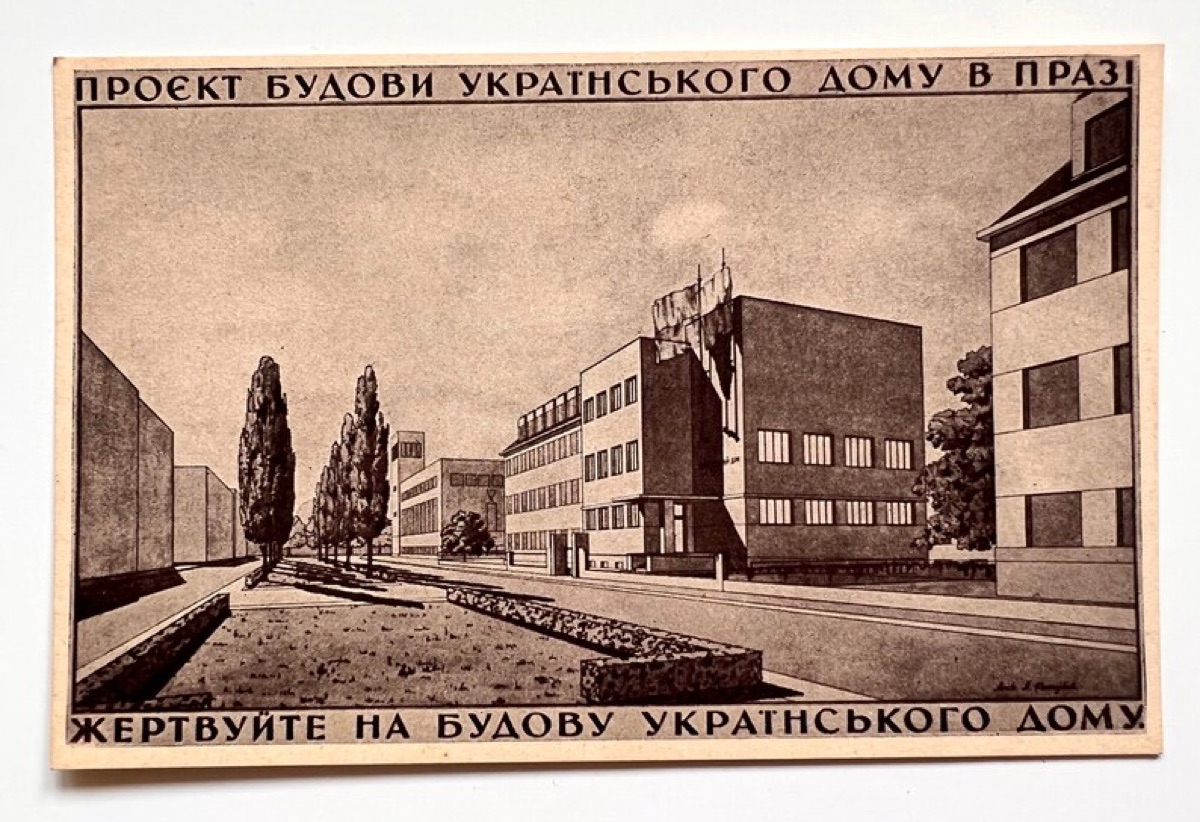
- 1938Purchase of the building; Ukrainian House photograph [M03; M04]
- 1939Opening of the museum in the adapted building [M03]
- 1943According to the encyclopedia, 140 museum-society members [M03]
- January 1945Inventory of statute collections [M04]
- February 1945Bombing and destruction of part of the archive [M02; M03]
- November 1945The name “Ukrainian Museum” [M01]
- March 1948Cessation of activities; 26.03 according to Mushynka [M01; M05]
- 1948, 1958, 1983Transfers of materials to the USSR (according to TsDAHO’s description) [M01]
- 1988Receipt of 117 boxes of documents at the former party archive [M01]
- 1997–1999Scholarly processing of unarranged documents [M01]
Full research text
Why this history is central to the cultural atlas
The Museum of Ukraine’s Struggle for Independence in Prague is one of interwar emigration’s most outstanding Ukrainian documentary projects. Established in 1925, it collected archives of Ukrainian National Republic diplomacy, military units and émigré societies, periodicals, visual art, photographs, libraries and material artefacts. Its history is simultaneously one of Ukrainian-Czech institutional connections and archives’ difficult fate during the war and after 1948. [M01; M02; M03]
Visual narrative: “The archive of a state they sought to preserve”. From the first museum bulletin and accession book of 1925 through the Ukrainian House, bombing and dispersal of collections to present archival references. This allows a sequence of documented decisions to be shown, rather than abstract “memory”. [M01; M04]
Organisation and four departments
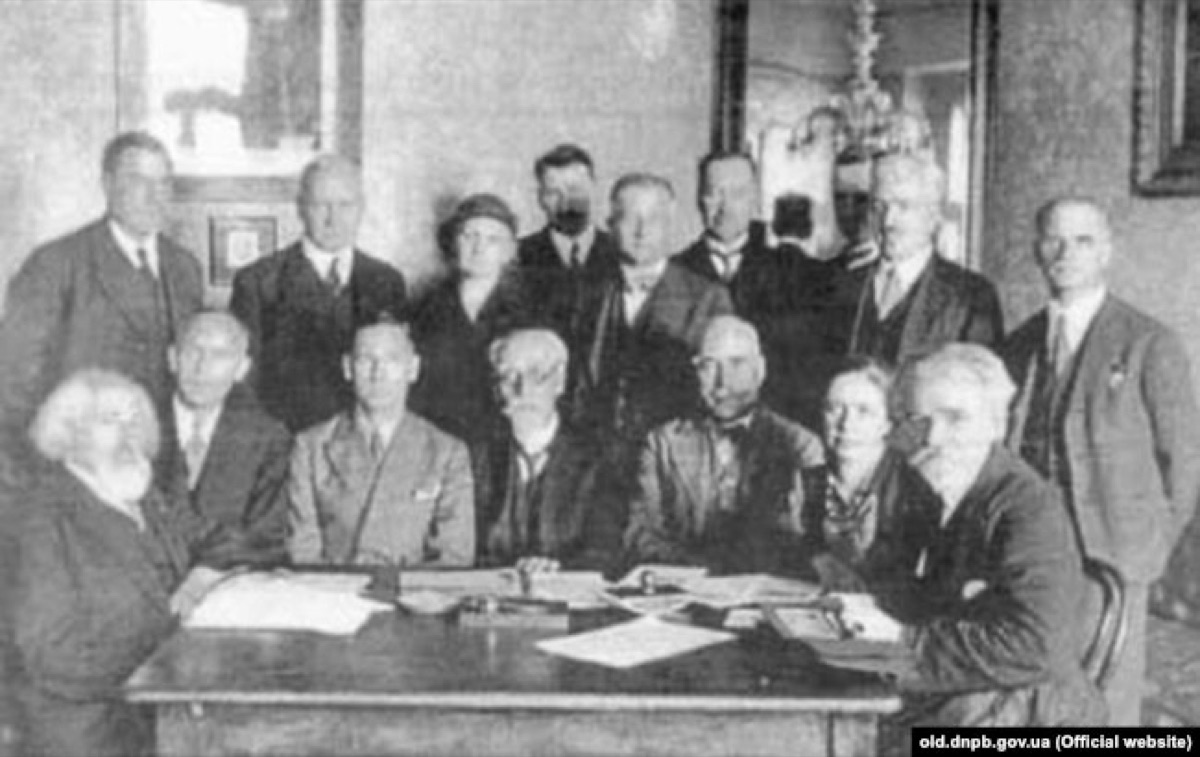
Professors of the Ukrainian Free University and members of the political emigration created the museum. Its distinctive feature was voluntary donation of documents and objects by people directly involved in the state-building events of 1917–1921. TsDAHO lists four historical departments: political-diplomatic, military, émigré and general. The general department included material objects, photographs, Ukrainian press and libraries. [M01; M03]
This structure provided a practical way to preserve an archive in emigration. The museum needed funds for premises, document description, shipping crates and publishing information. According to the Encyclopedia of Ukraine, its main support came from voluntary donations, particularly from North American Ukrainians; individual benefactors named include Yakiv Makohon and Kalenyk Lysiuk. This confirms an international funding network, but does not justify creating a personal-friendship relationship between every donor and the director. [M03]
The museum is not the society. Society R0050 had members and governing bodies, while museum R0040 had exhibitions, a library, an archive and a director. Equating the two legal names requires the statute; until checked, the database model has a founded_and_owned_by relationship. [M01; M03]
Collections: what objects were preserved
Diplomatic archives. Materials from the UNR’s foreign missions, ZUNR representations and diplomatic correspondence. These suit a digital exhibition mapping Ukrainian diplomacy in Europe, but every document needs authorship, a date, its original archive and accession route. [M01; M03]
Military and émigré holdings. Documents of the Ukrainian Sich Riflemen, internment camps, veterans’ communities, assistance committees and youth associations. Some early Plast correspondence from 1925–1928 is now described at TsDAHO (fond 269, file 984), so the museum network directly intersects with research on SUPE (R0048), but does not mean the museum directed SUPE. [M01; M08]
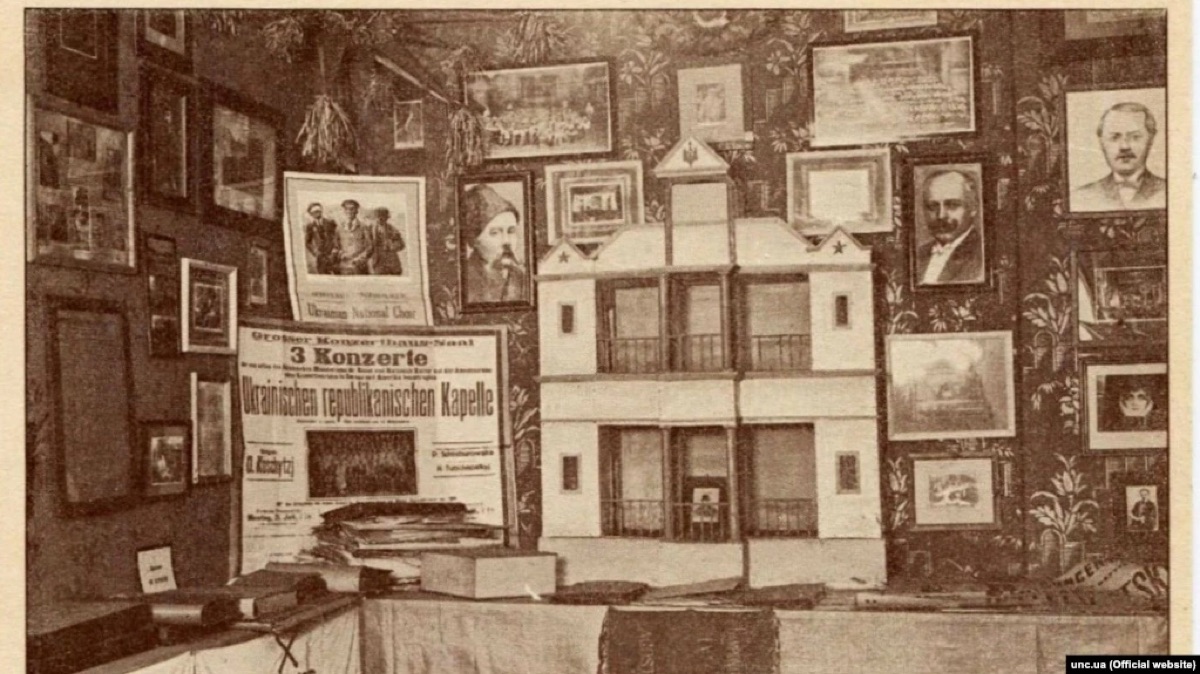
Art and print collections. According to the Encyclopedia of Ukraine, the museum had around 1200 periodicals, over 1400 prints and a library comprising more than 70 separate book collections. These figures belong to a historical description, rather than today’s fond 269. Their inventory boundaries and counts as of a particular year need confirmation through original catalogues. [M03]
People in the archive. One person’s documents can be held in several countries. Each record needs original_creator, collection_provenance, current_holding_institution, archive_reference, transfer_event fields. Such a provenance graph can reconstruct an archive’s route instead of misleading visitors with one notional “Museum archive” point. [M01; M02]
Premises, the Ukrainian House and the press
The museum initially used rented rooms, with some holdings in auxiliary repositories. A building adapted for museum work was purchased in 1938 and opened in 1939. TsDAHO’s exhibition presents a May 1938 photograph of the Ukrainian House — a valuable exhibit for a future façade reconstruction, but its map location must be established from cadastral and address materials. [M03; M04]
The museum published the information bulletin «Вісти Музею визвольної боротьби України»; the first page of its first issue, July 1925, survives at TsDAHO (fond 269, inventory 1, file 456, folio 1). Periodicals enable accessions, exhibitions and donors to be checked against specific issues, rather than memoirs alone. [M04]
War, losses and the documents’ postwar fate
Bombing. In February 1945 an air raid damaged the museum building, its holdings and premises. The Encyclopedia of Ukraine estimates losses at approximately a quarter of the collections; this is a secondary estimate requiring comparison with postwar inventory reports. The rest was relocated for storage, including to the Klementinum’s cellars and departmental archives. [M02; M03]
1945–1948. According to TsDAHO, the institution received the name “Ukrainian Museum” in November 1945. After D. Antonovych’s death, Symon Narizhny took charge. Activities proceeded under new political conditions, and according to researcher Mykola Mushynka’s reconstruction the museum officially closed on 26 March 1948. Treating this as one act of complete confiscation of all holdings is incorrect: confiscation, relocation and transfer occurred in several stages. [M01; M05]
Archival transfers after 1948. TsDAHO reports transfers of materials to the USSR in 1948, 1958 and 1983, and the receipt of 117 boxes of unarranged documents from the Ukrainian SSR’s KGB in 1988. Some holdings are in other Ukrainian and Czech state archives. Fond 269 also contains individual materials not originating in the original museum, so concluding that “all 1649 files belonged to the museum in 1945” is an error. [M01]
Specific references that can actually be requested
| Archival document / type | Custodian and reference | What it establishes |
|---|---|---|
| Extract from the society’s statute, January 1925 | TsDAHOU, fond 269, inventory 1, file 455, folios 1–2 | foundation, legal aims |
| First issue of «Вісти», July 1925 | fond 269, inventory 1, file 456, folio 1 | beginning of publishing activity |
| Ukrainian House photograph, 05.1938 | fond 269, inventory 1, file 456, folio 31 verso | specific façade and condition at that date |
| Benefactors’ commemorative book, 1936 | fond 269, inventory 1, file 457, folio 1 | public funding |
| Alphabetical accession book, 1925 | fond 269, inventory 1, file 458, folios 6,40,47 | object provenance |
| Membership card, 1930s | fond 269, inventory 1, file 460, folio 115 | museum society, membership |
| Extract from the inventory of statutes, 01.1945 | fond 269, inventory 1, file 455, folio 25 | state of arrangement before the strike |
| Plast unit correspondence, 1925–1928 | fond 269, inventory 1, file 984 | intersection with R0048 without legal subordination |
| Combined present “Ukrainian Museum” fond | TsDAHOU, fond 269, 3 inventories, 1649 files | present archival collection, NOT the original holdings count |
| Other archives | National Archives in Prague, Slavonic Library, Ukrainian regional archives | seek specific inventories for each branch |
References are based on published inventories and exhibitions, rather than physical examination of every file. [M01; M04; M08]
Typed relationships and network history
| Object | Relationship / period | Status |
|---|---|---|
| R0050 museum society | founded_and_owned → R0040, from 1925 | M01; M03 |
| R0019 Dmytro Antonovych | museum_director_of → R0040, 1925–1945 | M01 |
| Symon Narizhny | succeeded_as_director_of → R0040, 1945–1948 | M01 |
| R0002 Ivan Horbachevsky | chaired_owning_society → R0050, 1925–1935 | M03; precise minutes need checking |
| R0021 Smal-Stotsky | chaired_owning_society → R0050, 1935–1938 | M03 |
| Andrii Yakovliv | chaired_owning_society → R0050, from 1939 | M03; end uncertain |
| Dmytro Doroshenko | chaired_owning_society → R0050, until 1945 | M03; beginning uncertain |
| R0034 UFU | founding_professors_affiliated_with → R0040 | M01; the university does not own the museum |
| R0048 SUPE | fonds_hold_related_scouting_documents → R0040/museum | M08; not controlled_by |
| UNR diplomatic missions | records_collected_from → R0040 | M01; separate donor ID for each specific fond |
| Ukrainian diaspora in America | contributed_financially_to → R0050/R0040 | M03; amounts and donors from the commemorative book |
| TsDAHOU fond 269 | currently_holds_part_of_provenance → R0040 | M01; part, rather than the entire original museum |
| Klementinum | emergency_storage_place_for → R0040, 1945 | M02; exact date under verification |
Contradictions and key errors to avoid
| Assertion | Risk | Editorial decision |
|---|---|---|
| The museum “had a million exhibits” | sources do not clarify what was counted or when | Do not publish a count without a date and method |
| 1649 files = museum accessions in 1945 | this is present fond 269, also formed through later mixing | Separate contemporary_fonds_count and historic_inventory_count |
| Liquidation in 1945 or 1948 | major destruction / confiscation in 1945, end of the institution in 1948 | Separate damage, confiscation, institution_closed |
| Museum and society | legally different structures | R0040 ≠ R0050 |
| All holdings are now in Ukraine | some heritage remains in Czechia | holding_event graph and custodian verification |
| “A quarter destroyed” | secondary encyclopedic estimate | do not present as a complete expert report |
| Building and exact address | a photograph contains no coordinate record | block the point pending address research |
Connections
Mentioned in dossiers
- Andrij Jakovliv · Person
- Vasyl Bidnov · Person
- Augustyn Voloshyn · Person
- Stepan Smal-Stockyj · Person
- Ukrainian Institute of Sociology in Prague · Organisation
- Ukrainian Academic Hromada · Organisation
- Central Union of Ukrainian Students · Organisation
- Society of the Museum of Ukraine's Struggle for Independence · Organisation
- Ukrainian emigration in interwar Czechoslovakia · Event
- Founding of the Museum of the Ukrainian Liberation Struggle in Prague (1925) · Event
- Museum building hit in the air raid on Prague (14 February 1945) · Event
Sources
- M01 TsDAHO of Ukraine. «Колекція документів “Український музей в Празі” (1925–1948)», fond 269, 1649 files, historical description. e.tsdahou.archives.gov.ua
- M02 Tetiana Boriak. «Особові фонди діячів культури та науки у Державному центральному архіві в Празі», archival survey. old.archives.gov.ua
- M03 Internet Encyclopedia of Ukraine. “Museum of Ukraine's Struggle for Independence”. encyclopediaofukraine.com
- M04 TsDAHO of Ukraine. Archival exhibition «До річниці заснування Музею визвольної боротьби України в Празі». tsdahou.archives.gov.ua
- M05 Mykola Mushynka. «Музей визвольної боротьби України в Празі та доля його фондів», parts I–II, republication by Ukraine’s State Archive. old.archives.gov.ua
- M06 TsDAHO of Ukraine. Inventory 1 of fond 269, pages describing documents and organisations. e.tsdahou.archives.gov.ua
- M07 Ukrainian State Archive of National Memory. Online exhibition «100-річчя Музею визвольної боротьби України у Празі». hdauinp.org.ua
- M08 TsDAHO of Ukraine. Inventory 1 of fond 269, file 984, Plast unit materials. e.tsdahou.archives.gov.ua
Photos and videos
Verification
Draft
Research draft with sources; independent check still pending.
How we verify
- DraftResearch draft with sources; independent check still pending.
- Checked automaticallyQuotes mechanically matched to sources; an independent model found no contradictions.
- Two sources (automatic score)Automatic evidence score: key facts rest on at least two independent sources. No person has yet read the whole dossier.
- Confirmed by an editorAn editor confirmed the dossier; the reason is shown on the page. This is not an independent scholarly review.
- Disputed pointsSources disagree; disputed points are marked in the text.
Report an error or add information
Your message goes to the editorial queue. AI pre-sorts it, a human decides.