Organisation · Interwar Prague · Ukrainians in Czechia · R0050
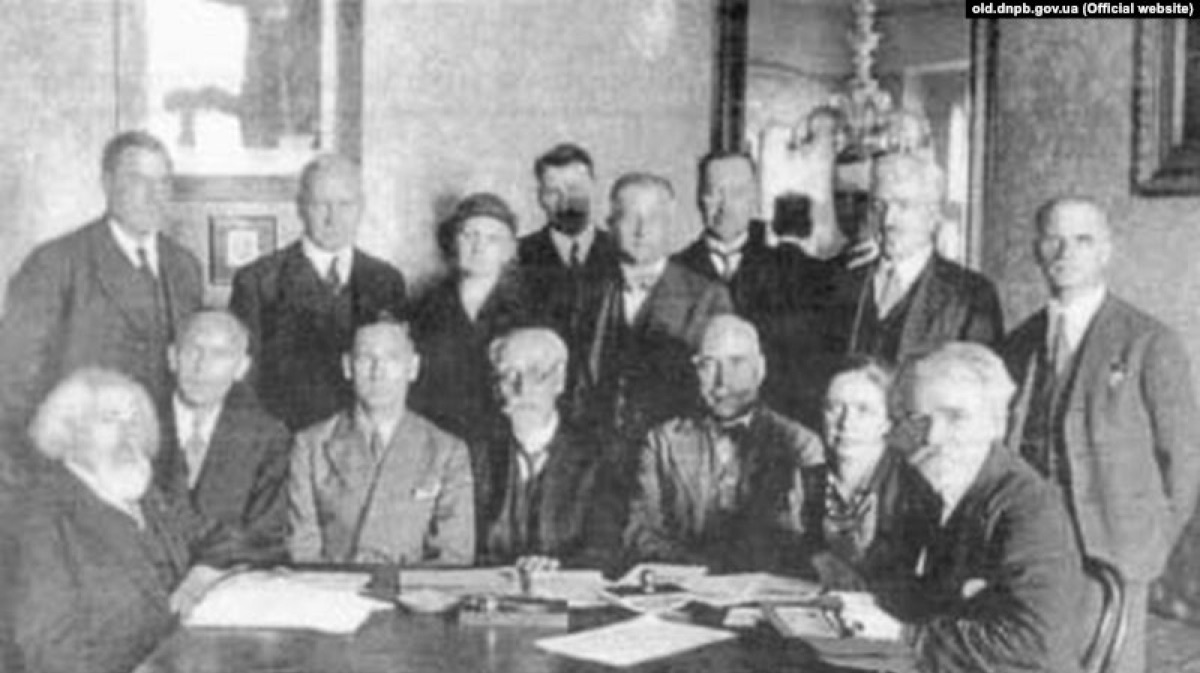
Society of the Museum of Ukraine's Struggle for Independence
Товариство «Музей визвольної боротьби України» · Spolek Muzea osvobozeneckého boje Ukrajiny · 1924–1978
Essence
The Society of the Museum of Ukraine's Struggle for Independence was established in Prague in 1925 to govern and support a Ukrainian exile museum. It organized donations, membership and decisions concerning collections. The Society and the museum institution must be distinguished when tracing wartime destruction and the subsequent dispersal of archival holdings.
Timeline
- 1924Initiative to establish a specialised Ukrainian museum in Prague. [MS02; secondary institutional account]
- 1925-01-12Statutes approved according to the Encyclopedia of the History of Ukraine; alternative 16 January date in earlier material. [MS03; source divergence]
- 1925-01Surviving extract from the society’s statutes: TsDAHO, f. 269, op. 1, file 455, fol. 1–2. [MS04; archival exhibition record]
- 1925-05-23Founding assembly of the society. [MS02; secondary institutional account]
- 1925-07-01First exhibition of the museum institution. [MS02; secondary institutional account]
- 1925-07First issue of Visty MVBU. [MS04; archival exhibition record]
- 1925–1945D. Antonovych heads the museum as director, distinguished from society chairs. [MS01; confirmed by a secondary source]
- 1929Support for the society and museum through donations by K.-H. Lysiuk. [MS01; confirmed by a secondary source]
- 1938Building purchased for the Ukrainian House in Nusle. [MS01; confirmed by a secondary source]
- 1939The museum begins operating in the purchased premises. [MS01; confirmed by a secondary source]
- 1943-02-27D. Doroshenko’s chairmanship start date from the previous research wave — minutes must be checked. [MS01; primary proof required]
- 1945-02Museum building destroyed by the bombing of Prague. [MS01; MS02; confirmed by a secondary source]
- 1945-04Decision to rename the organisation / museum the Ukrainian Museum. [MS01; secondary review]
- 1945–1948Museum director Symon Narizhnyi. [MS01; confirmed by a secondary source]
- 1948-03-26Date of museum and society dissolution according to the archival exhibition. [MS02; institutional claim]
- 1958Post-dissolution transport of a substantial part of the documents to the Ukrainian SSR. [MS01; history of collections]
- 1972–1978Formation of a separate Ukrainian Museum in Prague fond in the state archive. [MS01; history of collections]
Full research text
Why the museum needed a separate society
Prague's Museum of Ukraine's Struggle for Independence became an institution preserving documents about Ukrainian liberation struggles, diplomacy, culture and emigration. Museums, however, do not exist apart from the organisations that create, fund and protect them. This was why the museum society emerged in 1925 with its own statutes, membership, board, assemblies and legal decisions. Historian Maryna Paliienko and archival institutions document the distinction between the society's members, the museum director and the repository's structure. Reducing these to one object would confuse founders, ownership of collections and administrative management. [MS01; MS02; MS03]
In the CMS, R0050 should have a founded_and_governed relationship to R0040, but legal identity is unacceptable. A donation letter may be addressed to the society's board while the museum receives the exhibits; the person heading the society was not necessarily the museum director. This is a fundamental rule for every temporal graph on the platform. [MS01]
Background: documents without a home
After the First World War, Ukrainian military and political émigrés took abroad or preserved substantial documentary collections: records of the Ukrainian National Republic's army, the Ukrainian Galician Army, internment camps and diplomatic missions, as well as artistic and personal archives. According to the archival exhibition marking the museum's centenary, an initiative to create a place to preserve such historical material came in 1924 from Ukrainian Galician Army figures and was addressed to Ukrainian Free University professors. Dmytro Antonovych was among its principal initiators. [MS02]
This was more than a museum exhibition project. Rules were needed for accepting, organising and preserving documents, reporting to donors and funding. The society provided the civic foundation for this work, while the museum operated as its specialised organisation. Results should be assessed through meeting minutes, balance sheets, accession documents and bulletin issues, rather than memories of exhibition rooms alone. [MS01; MS04]
January and May 1925: three different dates
According to the Encyclopedia of the History of Ukraine, the society's statutes were approved by Prague's provincial government on 12 January 1925. The TsDAHO archival exhibition documents confirm the existence of a statute extract from January 1925 — f. 269, op. 1, file 455, fol. 1–2; this is an actual catalogue locator, but the complete statutes have not been checked here. Another institutional study gives 23 May 1925 as the date of the founding assembly. The project's initial materials instead contained an approval date of 16 January. No single date can therefore be designated a universal “founding date” without identifying the event type. [MS02; MS03; MS04]
The temporal model requires separate Event records: approval of the statutes, founding assembly and opening of the first museum exhibition. According to research by the Sectoral State Archive of the Ukrainian Institute of National Memory, the first display opened on 1 July 1925. The date of 16 January remains in the discrepancy register pending inspection of the original resolution. This distinction matters to the legal history of both museum and society. [MS02; MS03]
Donations: how a community created an institution
The society's principal resources were membership fees, private donations and diaspora support. Paliienko reports substantial contributions from K.-H. Lysiuk, a Ukrainian entrepreneur in the United States who provided assistance from 1929. Within museum history, this is a documented example of transatlantic resource mobilisation, but each contribution's specific sum and date should be established from cash reports. [MS01; MS04]
By the 1930s, the aim of a permanent “Ukrainian House” had taken shape. A four-storey building was purchased in Prague's Nusle district in 1938, and the museum began operating there the following year. Building ownership, the society's financial responsibility and storage of exhibits require different database fields. Purchase alone does not prove the building survives today: institutional history records extensive destruction in 1945. [MS01; MS02]
Who owned the memory: types of collections
The holdings included documents of Ukrainian governments and diplomatic missions, military material, flags, personal archives, early printed books, journals, artworks and photographs. According to the Encyclopedia of Modern Ukraine, the archive was divided into political-diplomatic, military, émigré and general departments. The library and museum operated separately. The collection was not static: material arrived from different countries and private collections. [MS01]
The society itself determined collecting policy and civic legitimacy. The Collection database needs separate records for museum objects, library holdings, diplomatic records and personal documents. Not all former exhibits can automatically be labelled “in Prague today”: some were destroyed, some removed and others dispersed among repositories in many countries. This distinction has both informational and ethical value for researchers. [MS01; MS02; MS05]
Visty MVBU as the society's diary
The bulletin Visty Muzeiu vyzvolnoi borotby Ukrainy appeared in 1925–1938. The Encyclopedia of Modern Ukraine website gives 19 issues, whereas Mykola Mushynka's work and exhibition material mention 20 issues. This is another source discrepancy: methods of counting combined issues or catalogue units may differ. The absolute figure is not being standardised until a complete run is inspected. [MS01; MS05]
Visty matters less simply as a museum publication than as systematic evidence of the society's activity: it contains board memberships, reports, thanks to donors, statutory amendments and invitations to join. The TsDAHO archive identifies the first issue, July 1925: f. 269, op. 1, file 456, fol. 1. The exact physical number of issues and the location of a complete run need establishing through separate bibliographic research. [MS04; MS05]
War, destruction and decisions to continue
The museum continued operating in difficult circumstances during Nazi occupation. Bombing of Prague destroyed the building in February 1945, and a substantial part of its collection was lost or relocated. This was a tragic event in the collections' material history, but it did not end the society's legal history. After the war, the organisation sought to arrange surviving documents, negotiate premises and preserve the institution. [MS01; MS02; MS05]
According to the Encyclopedia of Modern Ukraine, a general assembly approved renaming as the “Ukrainian Museum in Prague” in April 1945; Mushynka describes the society's postwar board under the name “Society Ukrainian Museum in Prague”. These names cannot all be treated as identical without registration records. In 1948, Czechoslovakia's communist authorities dissolved the museum and society; the institutional exhibition gives 26 March 1948, while the encyclopedia says March 1948. [MS01; MS02; MS05]
After 1948: collections without their original owner
The following decades brought large-scale transfers of collections. The Encyclopedia of Modern Ukraine reports the transport of more than ten tonnes of documents to the Ukrainian SSR in 1958, the formation of 173 fonds during archival processing and the preservation of some material in the Slavonic Library and Czech and Slovak repositories. A separate “Ukrainian Museum in Prague” fond was later formed in Prague. These historical facts should be represented as movements or custody histories of individual collections, rather than a single located_in edge. [MS01; MS05]
For organisation R0050, it is crucial to determine which collection decisions came from board members and which were imposed by external state institutions. In cases of forced seizure, “the society donated the archive” must not be written unless an act of voluntary transfer is found. The cautious relationship type custody_changed_under_political_control allows the story to be told without inventing legal grounds. [MS01; MS05]
Images and collections
- Extract from the society's statutes (January 1925) — TsDAHO, f. 269, op. 1, file 455, fol. 1–2; metadata confirmed by the public exhibition; digital reuse rights not established.
- Society membership card (1930s) — TsDAHO, f. 269, op. 1, file 460, fol. 115; do not assign an arbitrary date to its owner.
- First page of Visty (July 1925) — TsDAHO, f. 269, op. 1, file 456, fol. 1; compare with copies in other libraries.
- Photographs of the Ukrainian House in 1938 and ruins in 1945 — rights and exact provenance require separate investigation.
Connections
- Museum of Ukraine's Struggle for Independence in Prague · Organisation · 1925–1948
- Ukrainian Free University · Organisation · 1925
- Olšany Cemeteries · Place · undated
Mentioned in dossiers
- Andrij Jakovliv · Person
- Stepan Smal-Stockyj · Person
- Ukrainian Institute of Sociology in Prague · Organisation
- Diplomatic Mission of the Ukrainian People's Republic in Prague · Organisation
- Founding of the Museum of the Ukrainian Liberation Struggle in Prague (1925) · Event
- Museum building hit in the air raid on Prague (14 February 1945) · Event
Sources
- MS01 M. H. Paliienko, «Музей визвольної боротьби України», Encyclopedia of Modern Ukraine, 2020, secondary scholarly encyclopedia. esu.com.ua
- MS02 Sectoral State Archive of the Ukrainian Institute of National Memory, «100-річчя Музею визвольної боротьби України у Празі», archival exhibition, institutional exhibition. hdauinp.org.ua
- MS03 «Музей визвольної боротьби України», Encyclopedia of the History of Ukraine, secondary scholarly encyclopedia. resource.history.org.ua
- MS04 TsDAHO of Ukraine, «До річниці заснування МВБУ в Празі», catalogue of archival exhibition items with verifiable references, archival exhibition index. tsdahou.archives.gov.ua
- MS05 Mykola Mushynka, «Музей визвольної боротьби України в Празі та доля його фондів», State Archival Service of Ukraine, 2005, digitised research monograph. old.archives.gov.ua
Photos and videos
Verification
Draft
Research draft with sources; independent check still pending.
How we verify
- DraftResearch draft with sources; independent check still pending.
- Checked automaticallyQuotes mechanically matched to sources; an independent model found no contradictions.
- Two sources (automatic score)Automatic evidence score: key facts rest on at least two independent sources. No person has yet read the whole dossier.
- Confirmed by an editorAn editor confirmed the dossier; the reason is shown on the page. This is not an independent scholarly review.
- Disputed pointsSources disagree; disputed points are marked in the text.
Report an error or add information
Your message goes to the editorial queue. AI pre-sorts it, a human decides.