Person · National revival · Ukrainians in Czechia · R0002
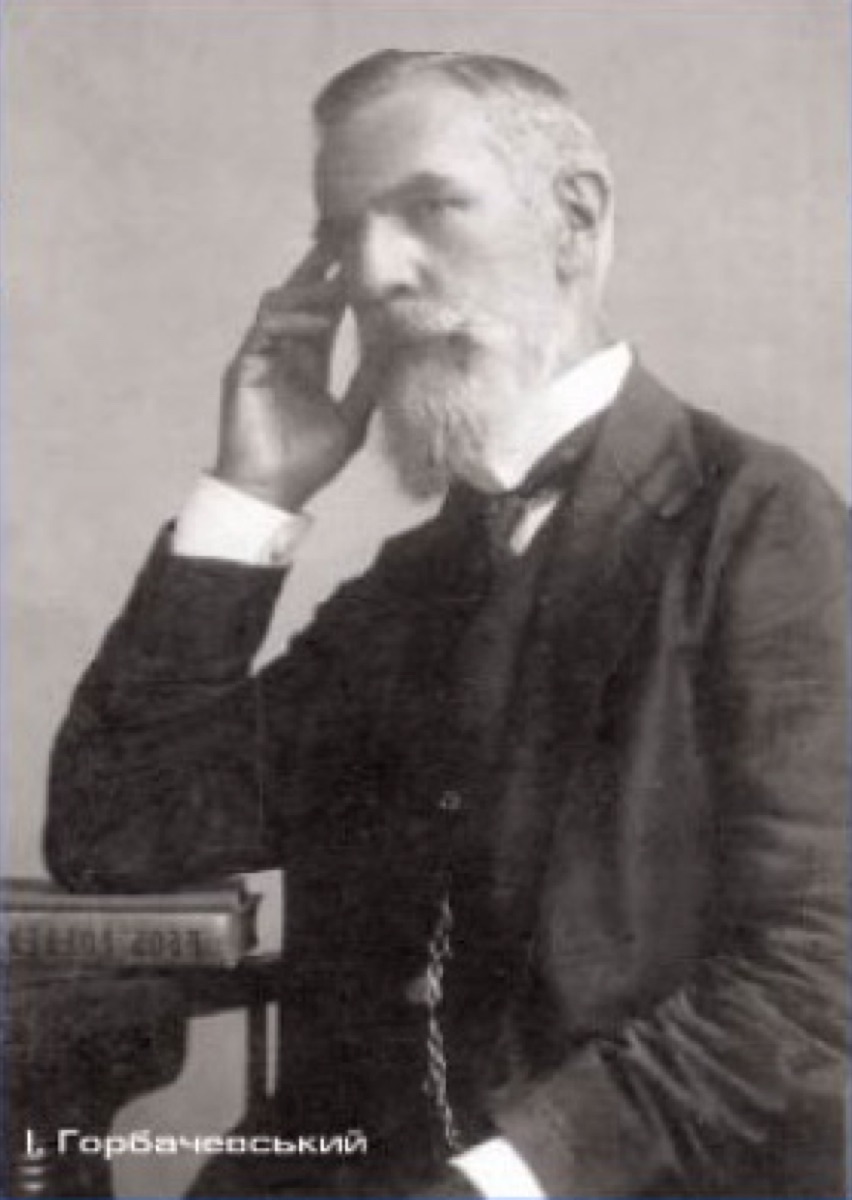
Ivan Horbaczewski
Іван Горбачевський · 1854–1942
Essence
Ivan Horbaczewski (1854–1942) was a Ukrainian-born chemist and physician whose academic career shaped medical chemistry in Prague. He served as rector of the Czech university in 1902/03, conducted important research on uric acid and later taught at Ukrainian émigré institutions in Czechoslovakia. His work bridges Czech and Ukrainian traditions of university education.
Timeline
- 1854Born in Zarubyntsi, Galicia. [H01, H03]
- 1880Completes university medical studies in Vienna. [H01]
- 1882Publication of the synthesis of uric acid. [H01, H03]
- 1883–1884Begins his professorship and the organisation of medical chemistry in Prague. [H01]
- 1889/90The first of his documented terms as dean. [H01]
- 1902/03Rector of the Czech university in Prague. [H02]
- 1904–1908Volumes of the textbook Chemie lékařská. [H01]
- 1917Austrian minister without portfolio responsible for public-health matters. [H01]
- 1918Minister for public health. [H01]
- 1923 and 1931Elected rector of the Ukrainian Free University. [H01; clarify the details of the terms in office against H03]
- 1924Obtains Czechoslovak citizenship. [H01]
- 1932Meeting with President Masaryk. [H01]
- 1942Death in Prague and burial in Šárka. [H01]
Full research text
The central story
Ivan Horbachevsky (1854–1942) was a physician and chemist of Ukrainian origin whose professional career was closely connected with Czech medical science over many years. A professor at the Czech Charles-Ferdinand University in Prague and its rector in the academic year 1902/03, he conducted fundamental research into the synthesis of uric acid and wrote a Czech textbook of medical chemistry. In 1917–1918 he held government responsibilities for public health in the Austrian half of the Habsburg monarchy, later teaching at Ukrainian émigré universities in Prague and Poděbrady. [H01, H02, H03]
This is a particularly clear example of a relationship working in both directions: a Ukrainian helped develop the Czech school of medical chemistry, then used his knowledge, scholarly authority and institutional experience for Ukrainian education in interwar Czechoslovakia. This was a succession of documented teaching, research and public roles, rather than a symbolic “bond between nations”. [H01, H03]
Personal record and historical names
| Field | Information |
|---|---|
| Ukrainian name | Ivan Yakovych Horbachevsky |
| Czech variants | Ivan / Jan / Johann Horbaczewski; Horbačevský |
| Life dates | 15 May 1854 — 24 May 1942 |
| Birth | Zarubyntsi, Galicia, in the territory of today's Ternopil region |
| Death | Prague, Hanspaulka district |
| Fields | Biochemistry, medical chemistry, hygiene, public health |
| Existing ID | R0002 — expand the record, do not duplicate it |
An important distinction: in 1902/03, the university's historical name was Česká univerzita Karlo-Ferdinandova v Praze, the Czech Charles-Ferdinand University in Prague. Modern popular accounts call it Charles University; a precise historical text should explain both names. Similarly, his ministerial position in 1917–1918 belonged to the government of Cisleithania, the Austrian half of the monarchy, rather than today's Austrian or Czech republics. [H01, H02]
Detailed biography
From Galicia to Prague. Horbachevsky came from a Greek Catholic priest's family, studied in Ternopil, and trained in medicine at the University of Vienna. Work in Viennese laboratories developed his expertise at the intersection of experimental chemistry and medicine. In 1882, he published research on the synthesis of uric acid, which received international recognition. In 1883, he was invited to become professor of medical chemistry at the Czech university in Prague, helping establish a new field of teaching and research. [H01, H03]
The development of Czech medical chemistry. In Prague, Horbachevsky developed teaching in medical chemistry, headed the relevant institute until 1917, and investigated purine bases, creatinine synthesis and the formation of uric acid. His Czech multi-volume Chemie lékařská (1904–1908) consolidated scientific terminology and systematised the course. He served repeatedly as dean of the medical faculty: in 1889/90, 1894/95, 1904/05 and 1911/12. [H01]
University rector. Charles University's official list of rectors explicitly names Ivan Horbaczewski as rector for the academic year 1902/03. This is strong primary evidence for institutional history. It helps avoid common confusion with Ivan Puluj, who had previously headed a different, German-language technical institution in Prague. A photographic narrative could clearly compare the two institutions, two Ukrainian professors and two distinct rectorships. [H02, P03]
A ministry of public health during wartime. In 1917, Horbachevsky joined the Austrian government as a minister without portfolio, tasked with establishing a central public-health authority; from July 1918, he was minister for public health. He worked during the Spanish influenza pandemic. The Czech academic biographical dictionary also describes the political controversies of his service in the Habsburg government, including the criticism expressed by some nationally oriented Czech circles after the monarchy's collapse. This is an important condition of an honest account, even on a website focused on positive stories. [H01]
A new phase — Ukrainian education in Czechoslovakia. After 1918, Horbachevsky withdrew from his official career at the Czech university, but became a leading teacher in Ukrainian émigré institutions. He taught at the Ukrainian Free University in Prague, the Mykhailo Drahomanov Ukrainian Pedagogical Institute, and the Ukrainian Husbandry Academy in Poděbrady. The Czech academic dictionary records his election as UFU rector in 1923 and 1931; the Encyclopedia of Ukraine gives longer terms. Published biographies should distinguish the election date from the full period in office. [H01, H03]
A person between two academic worlds. In 1924, Horbachevsky obtained Czechoslovak citizenship while retaining his Ukrainian scholarly and cultural identity. In 1932, Tomáš Garrigue Masaryk received him at Prague Castle in connection with support for the UFU. He died in Prague in 1942 and was buried at Šárecký Cemetery. His personal archive contains valuable evidence of links with universities and émigré circles. [H01, H04]
Places of remembrance and fieldwork
| Site | Proposal | Verification |
|---|---|---|
| Kateřinská 1660/32, Prague 2 | Memorial plaque at the historical institute; photograph of the façade | Address in H01; inspect the plaque in person |
| Na Kodymce 966/6, Prague 6 | House where the scholar died | Address in H01; respect its present private use |
| Šárecký Cemetery, Prague-Dejvice | The grave and the history of burial in Prague | Cemetery in H01; request the grave number |
| Charles University buildings | Context of the Czech medical school | The exact historical lecture room has not been identified |
| Zarubyntsi, Ternopil region | Birthplace and museum connection | Check current visiting arrangements |
Mark a historical address as “geographical data unknown” until the building is confirmed. Even a house number in the dictionary does not justify automatically publishing a grave marker or a private home on the map.
Scientific and archival legacy
- Synthese der Harnsäure (1882): an early study of uric acid synthesis. [H01]
- Chemie lékařská, a Czech multi-volume textbook (1904–1908). [H01]
- Orhanichna khimiia / Organic Chemistry (1925): a Ukrainian-language teaching legacy. [H03]
- Scientific work on creatinine, purine compounds, physiological chemistry, toxicology and public-health policy. [H01]
- A personal collection at the Czech Academy of Sciences Archive; its inventory is mentioned in the Czech academic dictionary. [H01]
- Collection No. 13 of the Central State Archive of Public Associations and Ukrainica: an inventory of Horbachevsky's personal materials from 1902–1974, comprising four archival files. [H04]
Further reading about this person
A catalogue confirms the bibliographic record. It does not mean that every dossier claim has been checked against the book’s full text.
-
About this person
Іван Горбачевський у спогадах і листуваннях
Ярослав Гонський
Укрмедкнига · 2004
Bibliographic record confirmed · Record checked 2026-11-02
Catalogue or publisher record ↗Text reading not documented
Sources
- H01 Institute of History, Czech Academy of Sciences. Salfellner, Harald. “HORBACZEWSKI Ivan 1854–1942”. Biografický slovník českých zemí 26, Prague 2023, pp. 64–65. biography.hiu.cas.cz
- H02 Charles University. “List of Rectors of the Czech Charles-Ferdinand University in Prague, 1882–1918”. cuni.cz
- H03 Encyclopedia of Ukraine. “Horbachevsky, Ivan Ya.”. encyclopediaofukraine.com
- H04 Central State Archive of Public Associations and Ukrainica. “Horbachevsky Ivan Yakovych…”, collection No. 13, inventory 1. e.tsdahou.archives.gov.ua
- H05 Shevchenko Scientific Society. “On the anniversary of Ivan Puluj’s birth”. ntsh.org
- H06 Bukovinian State Medical University. “I. Ya. Horbachevsky’s contribution to the development of biochemistry and medicine”. bsmu.edu.ua
- P03 Rozhledy matematicko-fyzikální 95/1 (2020), p. 47 onwards, a text about Puluj; the same source as R0001/P03, not checked again here. dml.cz
Photos and videos
Verification
Draft
Research draft with sources; independent check still pending.
Evidence coverage
Timeline claims assessed: 0 / 13. Claims with verified contradictions: 0.
The score measures coverage of timeline claims by verified sources, not the probability of historical truth. One independent source gives a claim 0.5 points; two or more give 1 point. A disputed claim receives 0. Unassessed claims remain in the denominator.
evidence-v1
How the score is calculated
Each claim shows its contribution to the score and verified current sources. Multiple references may share an origin; context adds no points.
-
1854
Born in Zarubyntsi, Galicia.
Not yet assessed Contribution: 0.0 / 1Independent source origins: 0
Verified current support has not been established. This does not mean the claim is false.
Report this claim -
1880
Completes university medical studies in Vienna.
Not yet assessed Contribution: 0.0 / 1Independent source origins: 0
Verified current support has not been established. This does not mean the claim is false.
Report this claim -
1882
Publication of the synthesis of uric acid.
Not yet assessed Contribution: 0.0 / 1Independent source origins: 0
Verified current support has not been established. This does not mean the claim is false.
Report this claim -
1883–1884
Begins his professorship and the organisation of medical chemistry in Prague.
Not yet assessed Contribution: 0.0 / 1Independent source origins: 0
Verified current support has not been established. This does not mean the claim is false.
Report this claim -
1889/90
The first of his documented terms as dean.
Not yet assessed Contribution: 0.0 / 1Independent source origins: 0
Verified current support has not been established. This does not mean the claim is false.
Report this claim -
1902/03
Rector of the Czech university in Prague.
Not yet assessed Contribution: 0.0 / 1Independent source origins: 0
Verified current support has not been established. This does not mean the claim is false.
Report this claim -
1904–1908
Volumes of the textbook Chemie lékařská.
Not yet assessed Contribution: 0.0 / 1Independent source origins: 0
Verified current support has not been established. This does not mean the claim is false.
Report this claim -
1917
Austrian minister without portfolio responsible for public-health matters.
Not yet assessed Contribution: 0.0 / 1Independent source origins: 0
Verified current support has not been established. This does not mean the claim is false.
Report this claim -
1918
Minister for public health.
Not yet assessed Contribution: 0.0 / 1Independent source origins: 0
Verified current support has not been established. This does not mean the claim is false.
Report this claim -
1923 and 1931
Elected rector of the Ukrainian Free University.
Not yet assessed Contribution: 0.0 / 1Independent source origins: 0
Verified current support has not been established. This does not mean the claim is false.
Report this claim -
1924
Obtains Czechoslovak citizenship.
Not yet assessed Contribution: 0.0 / 1Independent source origins: 0
Verified current support has not been established. This does not mean the claim is false.
Report this claim -
1932
Meeting with President Masaryk.
Not yet assessed Contribution: 0.0 / 1Independent source origins: 0
Verified current support has not been established. This does not mean the claim is false.
Report this claim -
1942
Death in Prague and burial in Šárka.
Not yet assessed Contribution: 0.0 / 1Independent source origins: 0
Verified current support has not been established. This does not mean the claim is false.
Report this claim
How we verify
- DraftResearch draft with sources; independent check still pending.
- Checked automaticallyQuotes mechanically matched to sources; an independent model found no contradictions.
- Two sources (automatic score)Automatic evidence score: key facts rest on at least two independent sources. No person has yet read the whole dossier.
- Confirmed by an editorAn editor confirmed the dossier; the reason is shown on the page. This is not an independent scholarly review.
- Disputed pointsSources disagree; disputed points are marked in the text.
Report an error or add information
Your message goes to the editorial queue. AI pre-sorts it, a human decides.